Chasing the Ghost in the Log: A Deep Dive into CVE-2026-20820

I enjoy reading patch analysis, so I decided to write my own. For the January Patch Tuesday, CVE-2026-20820 caught my eye.
It hits the Common Log File System (clfs.sys), a driver that has been a literal goldmine for Elevation of Privilege (EoP) bugs in the past years. Microsoft labeled it a “Heap-based Buffer Overflow” and tagged it “Exploitation More Likely.” At the time, the folks at BeFun Cyber Security Lab had already dropped a DoS PoC.
My goal? See if we can turn that “Denial of Service” into a nice “System Shell.”
The Hunt: Patch Diffing
I started by throwing the patched and unpatched versions of clfs.sys into Bindiff. One function stood out immediately: CClfsRequest::ScanContainers.
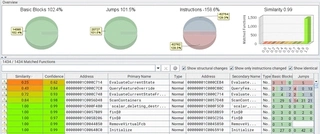
Microsoft loves wrapping their security fixes in A/B testing logic (Feature Descriptors) to toggle them on the fly. It makes our lives easier because it’s like a neon sign saying “THE BUG IS HERE.”
Opening it in Ghidra was… dense. That’s why I like to keep an IDA window next to it, comparing the two decompilers’ output can speed up the analysis.
The “Aha!” Moment
Looking at the IDA output for the patched version, the fix becomes obvious:
// The Fix: Microsoft added a check for the 0x38 header offset
if ((unsigned int)EvaluateCurrentState(&g_Feature_PatchDescriptor)) {
    // v15 = v15 + 0x38
    v2 = RtlULongAdd(v15, 0x38u, &v15);
    if ( v2 < 0 ) goto LABEL_ERROR;
}

// Check if our calculated size exceeds the actual buffer
if ( v15 <= *(_DWORD *)(v6 + 0x8) ) {
    // ... proceed to call the container scan
}
The logic before the patch was:
$$ v15 = maxContainers \times 0x240 $$The logic after the patch is:
$$ v15 = (maxContainers \times 0x240) + 0x38 $$Wait, so if the unpatched code forgets to account for that 0x38 offset, we can satisfy the length check while still overflowing the actual buffer? Let’s find out what these variables actually represent.
Reverse Engineering the Context
The raw decompile was a start, but it was still full of generic pointers and offsets. To actually see what the driver was doing when satisfying the length check, I needed to recover the object types. I imported Juan Sacco’s wdk_full_26100.gdt into Ghidra to get the proper clfsw32.h definitions.
Then, to resolve the C++ virtual calls, I ran a combination of my own scripts: CppClassExtractor.py to map the vtable pointers and DatatypeMerger.py to sync the PDB types with the new GDT.
Suddenly, the “mystery function call” after length check transformed into a clear call to ScanContainers().This is where the actual vulnerability lives, the driver takes the results of its container scan and writes them into a destination buffer, represented here by v3:
// After applying custom GDTs and vtable reconstruction
// (I kept IDA variables' name)
v2 = (*((CClfsLogFcbPhysical *)this->fcb)->vptr_for_CClfsLogFcbCommon->ScanContainers)(
        (CClfsLogFcbPhysical *)this->fcb,
        (_CLS_CONTAINER_INFORMATION *)((longlong)v3 + 0x38), // The target buffer
        v12,
        v10, // maxContainers
        &v17,
        Priority,
        &v16
     );
By tracing v3 (which eventually becomes our buffer), I saw it coming from MmMapLockedPagesSpecifyCache(). This is a crucial pivot: it confirms the driver is creating a System Virtual Address mapping for a buffer we allocated in User Space.
Essentially, the driver takes our user-mode memory pages, locks them in physical RAM so they can’t be paged out, and then maps them into the kernel’s high-address memory range so clfs.sys can write the scan results directly into them.
This is standard driver behavior for I/O:
- The user provides a buffer in their process.
- The kernel creates an MDL (Memory Descriptor List) describing the physical pages of that buffer.
- The driver calls
MmMapLockedPagesSpecifyCache()to get a kernel-accessible pointer (v3) to those same physical pages.
I fired up WinDbg and set a breakpoint on CLFS!CClfsRequest::ScanContainers. Using a Microsoft code sample for log container enumeration (and replacing OPEN_EXISTING by OPEN_ALWAYS in CreateLogFile() since I was starting fresh), I hit the breakpoint.
1: kd> ? rax  # This is v15
Evaluate expression: 576 = 00000000`00000240
1: kd> dd @r14+8 L1 # This is the buffer size check
ffffe588`a9c2dc58  00000278
The math check out. 0x240 (one container) is less than 0x278 (the buffer size). But the code then tries to write to that buffer starting at offset 0x38.
If we have a buffer of size 0x240, the check passes because 0x240 <= 0x240. But when the driver starts writing at buffer + 0x38, it will write 0x240 bytes, ending at 0x278. That’s a 0x38-byte out-of-bounds write.
Triggering the Bug
The standard WinAPI CreateLogContainerScanContext() is too “safe”, it always allocates enough room for the header. To trigger this, we have to go lower. We need DeviceIoControl().
After digging through CClfsRequest::Dispatch, I found the IOCTL code: 0x80076816.
The trick here is memory alignment. If we just allocate a small buffer, the overflow might stay within the same 4KiB page and land in a harmless spot. To get a stable crash (and eventually an exploit), we want that overflow to cross a page boundary into unmapped or protected memory.
I used VirtualAlloc() to grab a page and placed my buffer right at the end:
SIZE_T cInfoSize = 0x240;
BYTE* pageEnd = base + page;
BYTE* outBuff = pageEnd - cInfoSize; // Align buffer to the very end of the page

// ... fill outBuff with required CLFS headers ...

DeviceIoControl(logHndl, 0x80076816, NULL, 0, outBuff, cInfoSize, &bytes, NULL);
Full PoC can be found on Github gist
Result: Blue Screen of Death
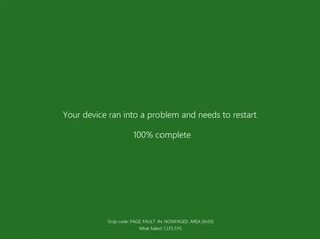
Running the PoC results in a beautiful PAGE_FAULT_IN_NONPAGED_AREA.
Arg1: ffffe300714c4028, memory referenced. (The address just past our page)
Arg2: 0000000000000002, Write operation.
Arg3: fffff80267d86c0f, Instruction address.
The Reality Check: Is it exploitable?
Microsoft called this a “Heap-based Buffer Overflow.”. It isn’t.
Since the buffer is mapped via MDL from user space into system space, it’s not sitting on the traditional Kernel Pool. This means no Pool Header corruption.
To get EoP, we would need to find a way to make the kernel map a critical structure immediately following our buffer in the virtual address space. And with that, the data we overflow is also constrained:
p_Var7->State = ...;
p_Var7->PhysicalContainerId = ...;
p_Var7->LogicalContainerId = ...;
We are overwriting with container IDs and state flags at fixed positions. Unless you can find a structure that can be put next to it and where overwriting a few bytes at the beginning with a 0x00000001 leads to code execution, this is likely “just” a DoS.
If you’ve found a way to groom the System VA space to make this useful, hit me up.
